| Article number: | 10.10.008 |
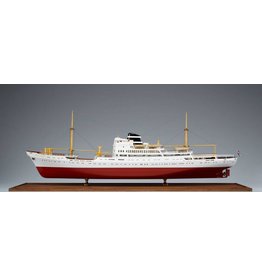
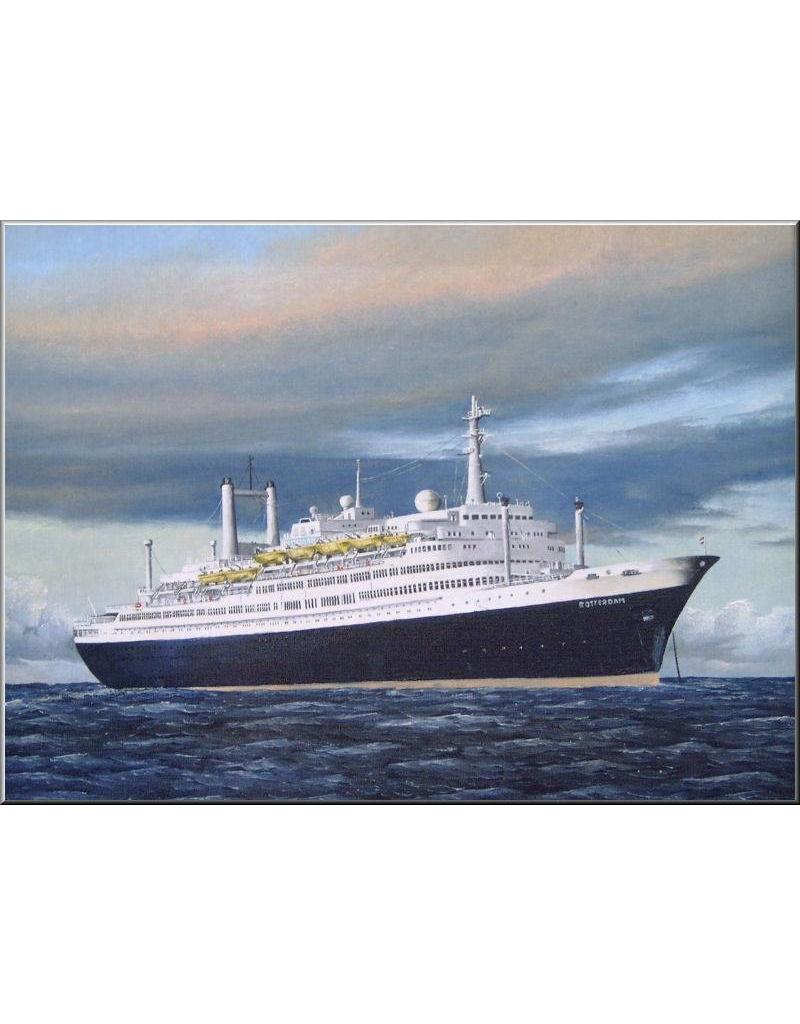
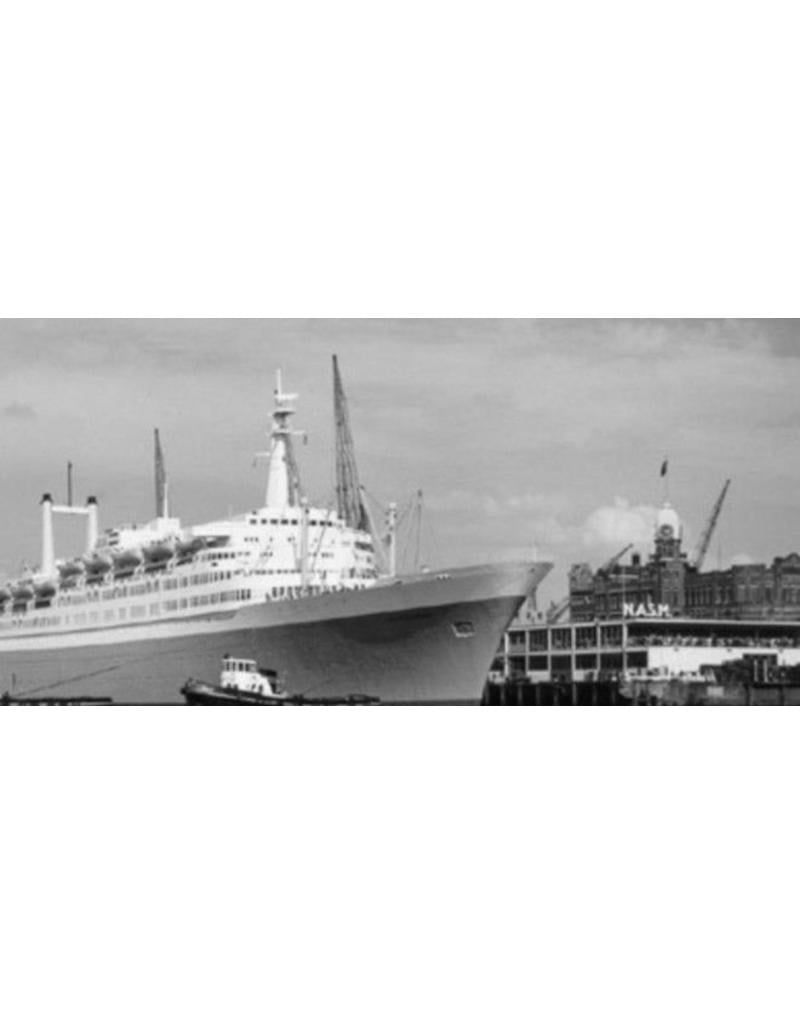
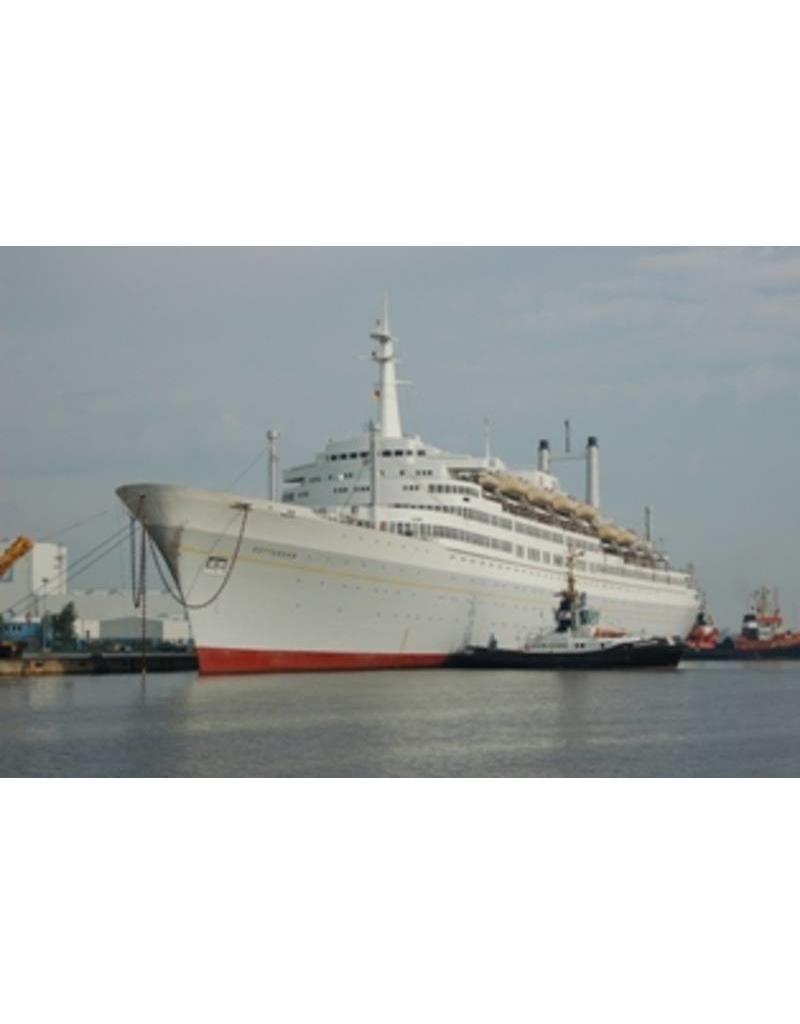
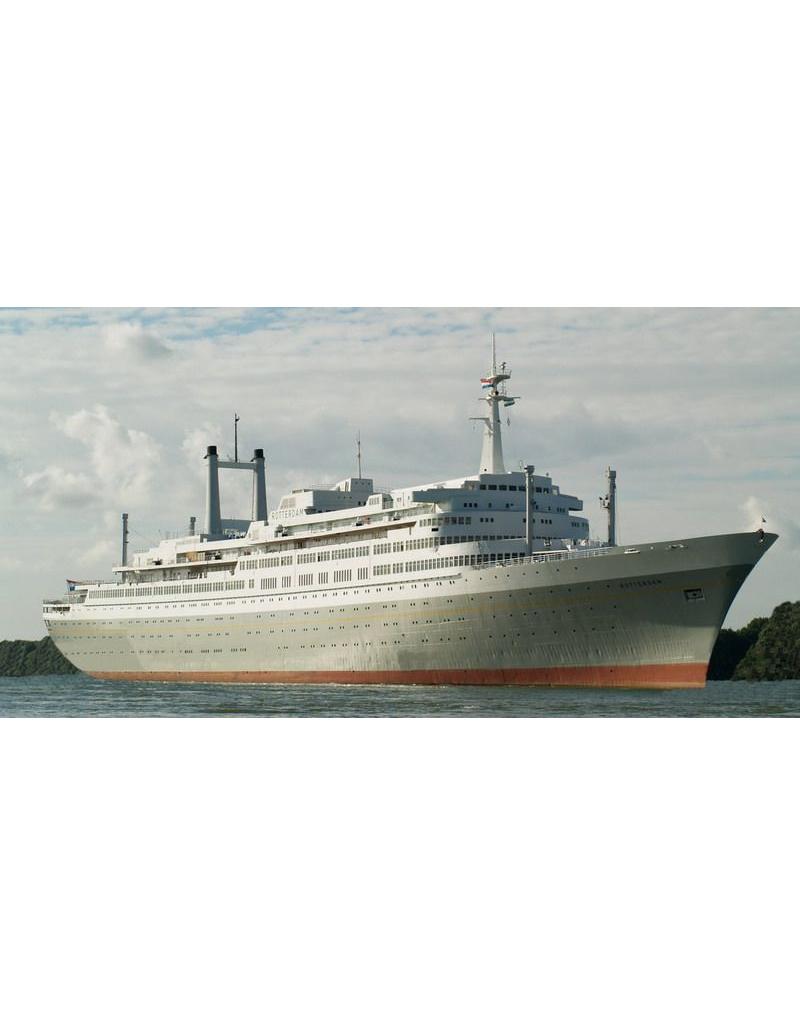
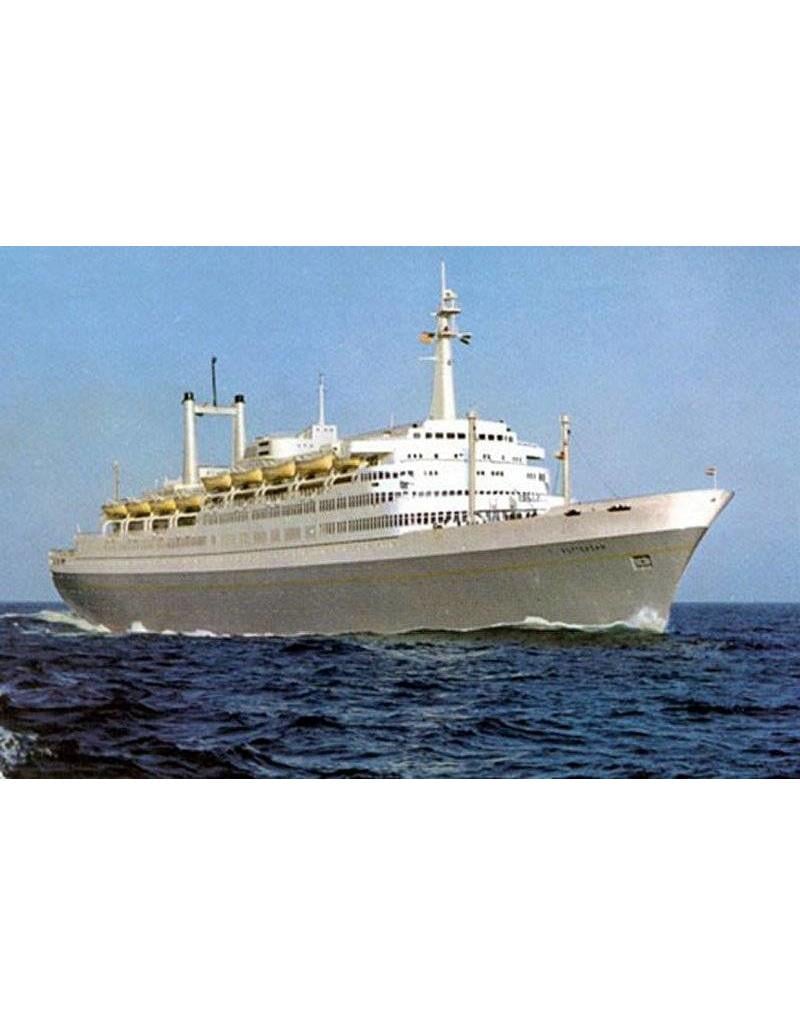
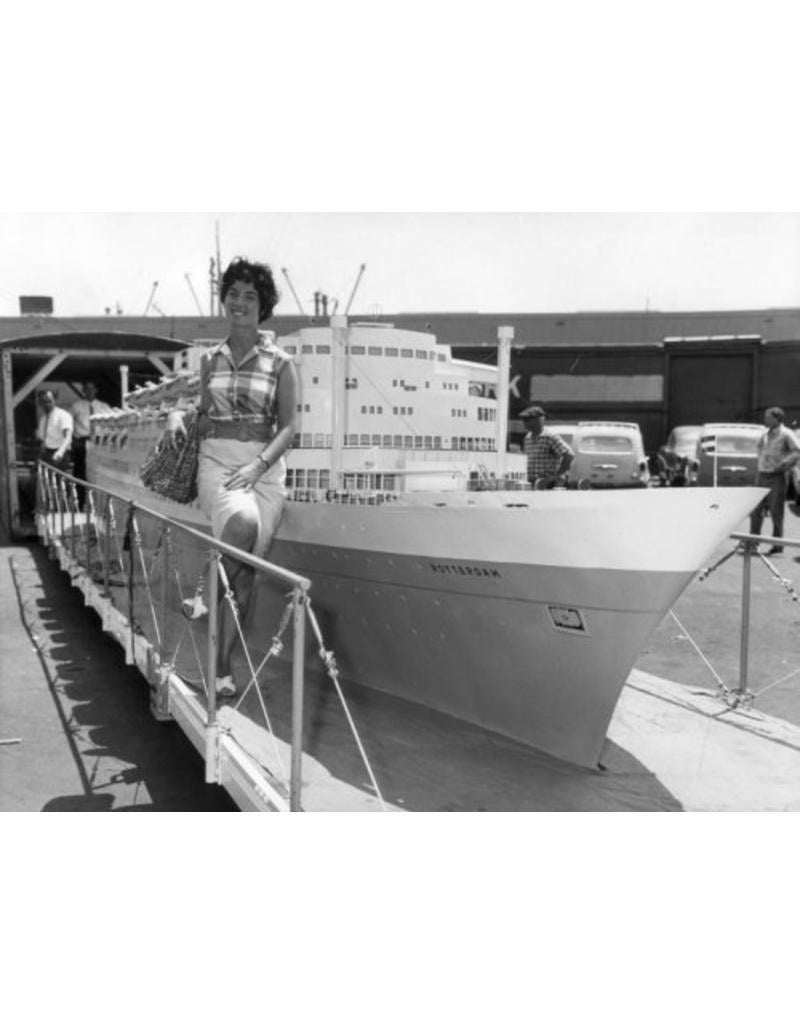
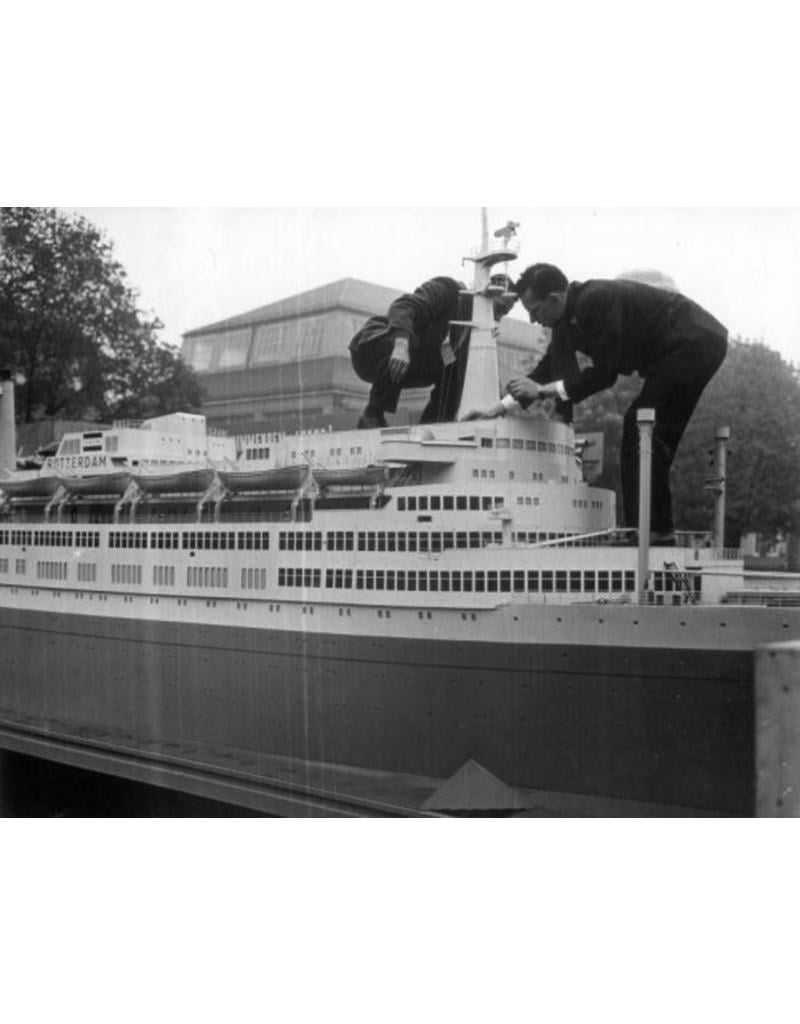
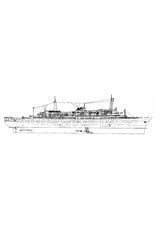
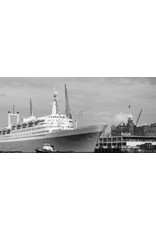
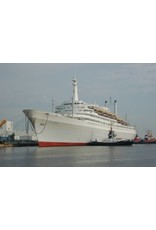
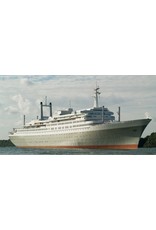
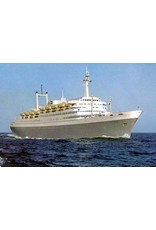
The SS Rotterdam, built in 1959, is the fifth ship to bear that name, in service with the Holland-America Line (HAL). It is a steamship with oil-fired boilers and steam turbines.
It is one of the best-known post-war Dutch passenger ships. Between 1959 and the end of 2000, it was part of the final decade of transatlantic liner service and subsequently served as a successful cruise ship. Since 4 August 2008, the ship has been moored as a floating attraction (guided tours, hotel-café-restaurant) at the Derde Katendrechtse Hoofd in the Maashaven in Rotterdam.
Design
The Rotterdam was originally designed as a ‘running mate’ for the popular Nieuw Amsterdam of 1938, but the design work was halted as a result of the outbreak of the Second World War. By the time economic conditions had improved sufficiently for the ship’s construction to be reconsidered in early 1954, it was already clear that the era of the transatlantic passenger ship was coming to an end.
The designers had this in mind when they designed a highly innovative ship: a two-class vessel, horizontally divided by removable partitions, and featuring a unique double stairwell that allowed for a simple conversion to a single-class layout.
The engine room was situated three-quarters of the way aft, and instead of funnels, the ship was fitted with two modern flues. To give the ship a streamlined profile nonetheless, a large deckhouse was placed on top of the superstructure amidships, where the funnel would normally be situated. This made it a controversial ship for its time, but this profile would later prove to be groundbreaking, and various elements of the design can be found in later cruise ships.
Construction
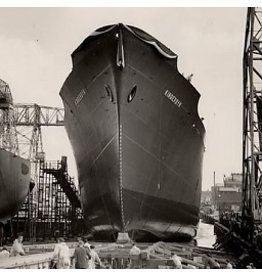
On 27 October 1955, the Holland-America Line ordered the ship from the Rotterdamsche Droogdok Maatschappij NV (RDM) in Rotterdam. On 14 December 1956, the keel of the ship was laid under construction number 300. The christening and launch on 13 September 1958 by Queen Juliana was a huge crowd-puller, watched by tens of thousands of onlookers on both banks of the river and captured on camera.
The first trial run took place on 11 July 1959; the technical trials were held from 1 to 6 August; and on 20 August 1959, during the official trial run, once again in the presence of Queen Juliana, the shipyard handed the vessel over to HAL.
Technical specifications
The ship’s propulsion consists of four steam boilers (three active, one reserve), which supply steam to three Parsons steam turbines: a high-pressure, a medium-pressure and a low-pressure turbine, all built by the Royal Schelde Company in Vlissingen, each of which, via double-reduction gearboxes and shafting, is coupled to two bronze, three-bladed propellers with fixed pitch, which together deliver a power output of 35,000 hp at 135.5 revolutions per minute. Because of these steam engines, the ship is also known as the SS Rotterdam, with SS standing for steamship.
Holland-America Line
Liner service
In the first ten years, the HAL mainly deployed the Rotterdam from April to December on the transatlantic route between Rotterdam and New York; outside the season, the ship undertook cruises. Thus, on 3 September 1959, the ship departed from Rotterdam for its maiden voyage to New York. On this route, Le Havre and Southampton were usually called at.
The ship made only four crossings in this first season, as on 11 December it began its first cruise, a 49-day voyage of 14,878 nautical miles calling at sixteen ports in Central and South America, followed by a 75-day four-continent cruise. In April 1960, it resumed its transatlantic service. This pattern would be repeated in the years that followed.
In 1961 and 1962, the Rotterdam undertook a round-the-world cruise from February to April. The advertising slogan was ‘around the world in eighty days’. The voyage was fully booked, mainly with wealthy Americans. The journey took the ship from New York across the Atlantic Ocean, through the Mediterranean Sea and the Suez Canal to India.
It then called at Taiwan, Hong Kong and Yokohama. This was followed by the long crossing to Hawaii, then on via California and Mexico through the Panama Canal back to New York.
By this time, air travel had completely supplanted transatlantic passenger shipping. In 1968, HAL therefore announced that it would deploy the ‘big three’ in its fleet – the Nieuw Amsterdam (II), Statendam (IV) and Rotterdam – almost exclusively for cruise operations and would refit them for this purpose. The Rotterdam returned to Rotterdam on 3 October 1968 from its final transatlantic voyage and proceeded to RDM for the refit.
Cruise operations
Following a two-month refit at RDM, during which the ship was fitted out for use exclusively as a cruise ship, it departed Rotterdam again on 9 December 1968. A more or less regular pattern emerged of winter cruises in the Caribbean and summer voyages to Alaska.
The months of January to April were reserved for the traditional world cruise, which the Rotterdam had taken over from the Statendam as early as 1961. HAL’s round-the-world cruise, lasting approximately eighty days, became a household name, and an ever-increasing number of passengers, particularly Americans, developed a long-term, more or less regular relationship with the ship as a result.
Due to the cruise business being primarily focused on the American market and the increasing efficiency at HAL, the ties with the Netherlands and the home port of Rotterdam became increasingly tenuous. In the first three years following the refit, the Rotterdam still made a special trip from North America to Rotterdam for its annual dry-docking, to which the shipping company cleverly attached two transatlantic crossings.
But even that could be done more cheaply, and from 1972 maintenance took place at shipyards in America. This severed the relationship with Rotterdam, and after a final dry-docking in Rotterdam, the ship left its home port on 6 October 1971. It would be 27 years before the ship, under a different name, would call at the port of Rotterdam again.
Other things changed too. After a modernised logo had already replaced the old HAL emblem on the central superstructure, further changes in the years that followed made the ship seem less familiar: in April 1973, it was registered under the cheaper flag of the Netherlands Antilles and had ‘Willemstad’ painted on the stern as its home port. At the same time, the owner changed its name to Holland America Cruises and, in October 1973, the grey hull was painted blue.
With the emergence of ever more modern and larger cruise ships, including for the lower market segments, and the phasing out of older tonnage by other shipping companies, the ship, nicknamed the ‘Grand Dame’, slowly became an icon of a bygone era. A certain group of particularly affluent passengers found this appealing and chose to cruise on the Rotterdam for that very reason. The ship therefore remained an important source of income for the company.
Holland America Cruises also realised that not every modernisation was an improvement and that drawing on the Dutch past could go down well with the predominantly American clientele. From 1986, the shipping company reverted to the name Holland America Line and introduced a new logo incorporating the old logo.
In 1989, the tourism division of HAL was sold to Carnival Cruise Lines in Miami, but continued to operate under its own name. Carnival, too, was keen to capitalise on HAL’s solid Dutch reputation and the special place the Rotterdam had come to occupy in the cruise world. This was evident from the investment Carnival made when the ship underwent a major refurbishment in September 1989 at Northwest Marine Ironworks in Portland, Oregon.
Nevertheless, in the 1990s the Rotterdam also had to comply with ever-tightening SOLAS safety requirements, which necessitated further modifications to the ship. Ultimately, this was no longer profitable for the shipping company.
To the dismay of a large group of regular cruise passengers, HAL therefore announced in 1997 that the ship would be taken out of service and that a replacement had been ordered, which would enter service as the Rotterdam (VI). With a ‘gala final cruise’, the Rotterdam ended its last cruise season in Fort Lauderdale on 30 September 1997.
Premier Cruises
On 3 October 1997, the ship was acquired in Norfolk by the American cruise company Premier Cruises, a company that saw a market in the operation of older, second-hand ships fitted with steam turbines. The company registered the ship under the Bahamian flag, with Nassau as its home port, and renamed it Rembrandt, in order to retain its Dutch identity and loyal customers. It was upgraded in Norfolk and Freeport in the Bahamas to meet new safety requirements and set sail on its maiden cruise from Brazil on 8 December 1997.
In May 1998, its operating area was shifted to Europe, where the programme concluded on 26 October 1998 in Rotterdam, its former home port, after a 27-year absence. Amidst great interest, the ship spent two nights at the familiar Wilhelminakade before setting off on a classic route: a transatlantic crossing via Southampton to New York.
However, Premier Cruises unexpectedly ran into financial difficulties in 2000 and on 14 September, whilst on a cruise in Halifax (Nova Scotia), the Rembrandt was impounded at the request of an American investment bank. After the passengers had disembarked, the ship was laid up in Freeport on 21 September.
Preservation
Meanwhile, in May 2001, the Stichting Behoud Stoomschip Rotterdam (Foundation for the Preservation of the Steamship Rotterdam) had been established, dedicated to preserving the ship as maritime heritage. The foundation’s aim was to moor the ship in Rotterdam once again as a static attraction with a new function.
After countless rumours and problems, the investment bank transferred the ship on 1 May 2003 to RDM BV, a company owned by corporate turnaround specialist Joep van den Nieuwenhuyzen, who placed the ship in a separate company: ss Rotterdam BV. The required sum, the scrap value of five million euros, was pre-financed by the Rotterdam Municipal Port Authority (GHR). The aim was to convert the ship into a floating hotel, restaurant, conference centre and casino in Rotterdam.
After lying idle for three years and nine months, the Rotterdam set sail on 17 June 2004, towed by a tugboat from Freeport to Gibraltar, where it was moored on 12 July 2004. Here, the initial preparatory work for the renovation was carried out: an inventory of the various asbestos applications. By August, the ship’s old name and home port had been restored.
Meanwhile, ss Rotterdam BV had become embroiled in financial disputes between the various companies owned by Joep van den Nieuwenhuijzen and the GHR, which led to the resignation of director Willem Scholten.
For a short time, the GHR was the owner of the Rotterdam, until on 30 June 2005 the ship was sold to a new owner, Rederij De Rotterdam BV, established by the Woonbron housing association and investment company Eurobalance BV, which later withdrew, in collaboration with Woondrechtconsult (part of Woonbron), Albeda College and Inholland University of Applied Sciences.
The background of the new owners is reflected in the new objective: a conference centre, hotel, restaurant and training centre, permanently moored at a quay made available by the municipality at the Derde Katendrechtse Hoofd in the Rivierkwartier in the Katendrecht district of Rotterdam.
On 24 and 25 November 2005, the Rotterdam was towed from Gibraltar to Cádiz, where it was placed in a dry dock to be completely repainted in its original colours. In the meantime, a shipyard in Gdańsk had been selected for the final refurbishment.
Once again, a tugboat secured the vessel and the tow departed from Cádiz on 10 February 2006. During the voyage, the Rotterdam passed the Dutch coast on 19 February, a moment captured by an aerial photographer. On 27 February, the ship was moored at a pier in Gdańsk.
Problems arose in Gdańsk, caused by bags of asbestos-containing materials that were still on board, which, according to the Polish authorities, was prohibited. Prolonged bureaucratic complications, in which protected swallows nesting on board also played a part, have since held up the planned work on the ship. Ultimately, the Polish authorities decided that the Rotterdam had to leave.
On 25 August 2006, the ship left the port of Gdańsk under the tow of a tugboat and arrived in Wilhelmshaven on 2 September. There, the asbestos waste was removed and the ship was thoroughly refurbished and prepared for its new roles in Rotterdam.
Berth
Berth at Katendrecht
On 2 August 2008, the Rotterdam left Wilhelmshaven, towed by two tugs, for its current berth at the Derde Katendrechtse Hoofd. There, on 4 August, the ship was towed in and moored amid great interest. Following further renovations and modifications, the ship opened to the public on 15 February 2010. From February 2007, an information centre had been open at Brede Hilledijk 99, where visitors could view a photo exhibition and obtain information about future and planned events.
Specifications:
|
Drawing number |
10.10.008 |
|
Author |
H. Groen |
|
Description |
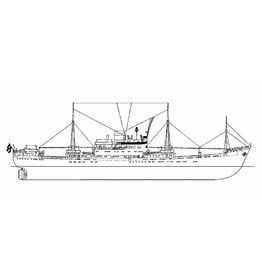
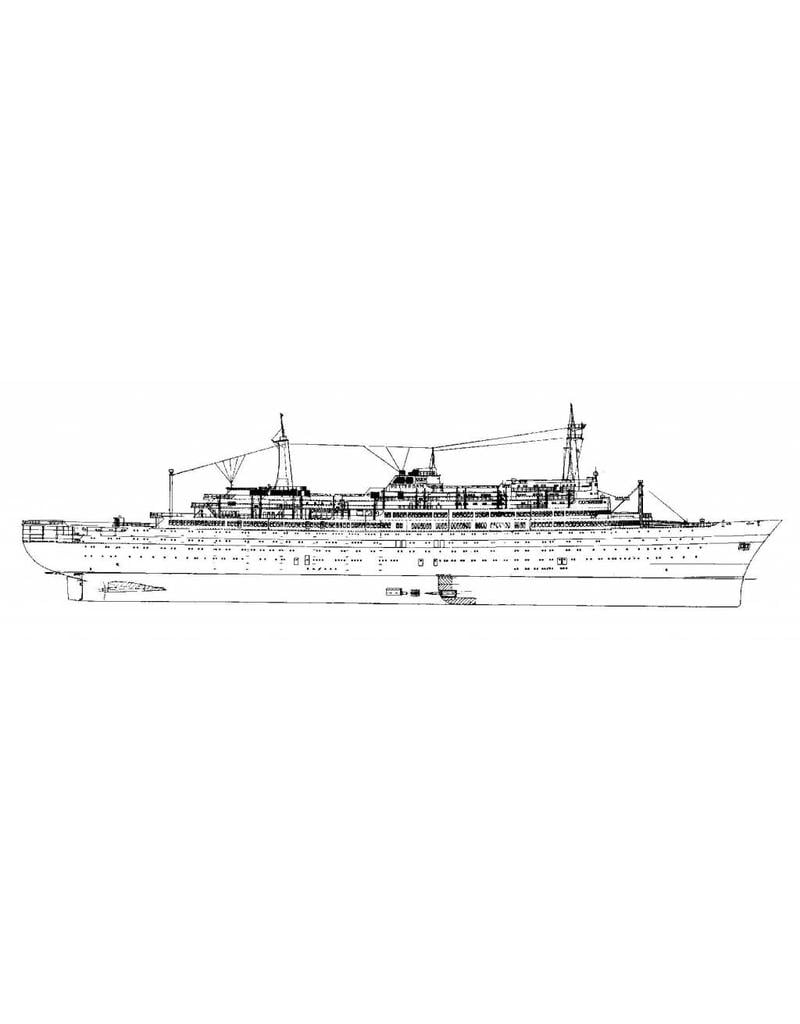
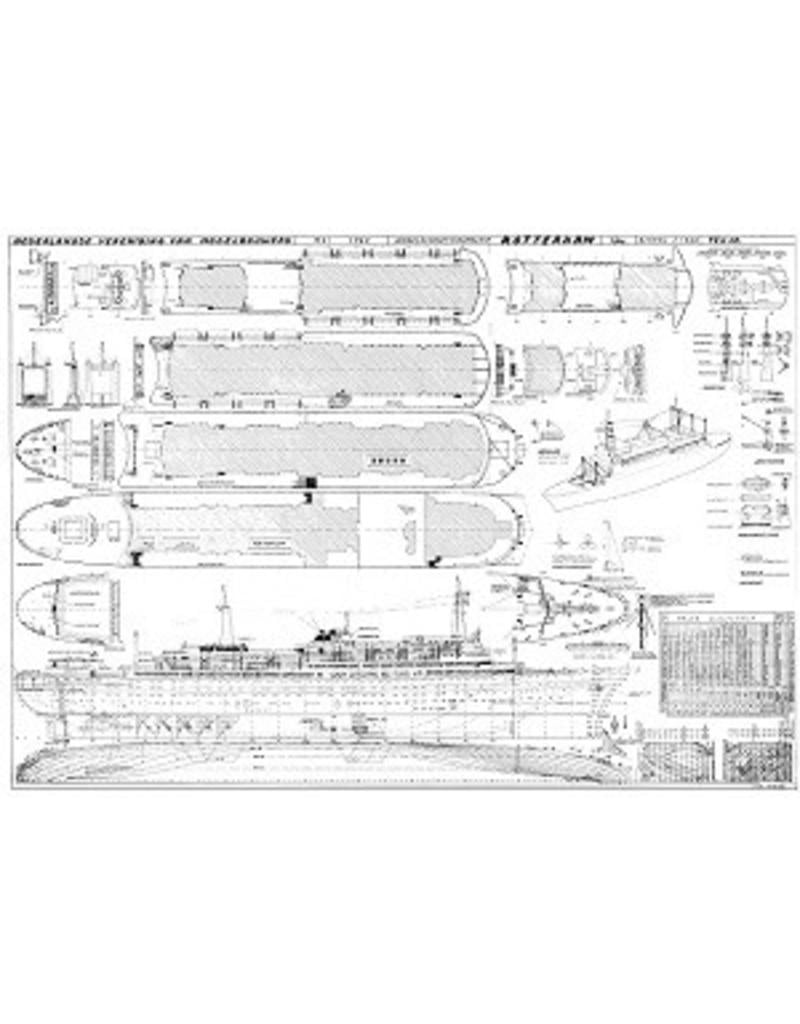
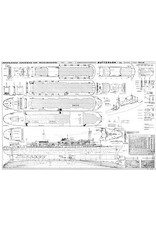
Passenger ship SS "Rotterdam" (1956) - HAL |
|
Quality |
line drawings; side view; deck plans; rigging diagram; details; instructions for model building |
|
Scale |
1 : 250 |
|
Number of A00 sheets |
0 |
|
Number of A0 sheets |
1 |
|
Number of A1 sheets |
0 |
|
Number of A2 sheets |
0 |
|
Number of A3 sheets |
0 |
|
Number of A4 sheets |
0 |
|
Total number of drawing sheets |
1 |
|
Number of A4 text pages |
0 |
|
Weight in grams |
105 |
|
Details |
Overall length 91 cm |
|
Remarks |