| Article number: | 10.19.007 |
The bucket dredger is one of the oldest tools in hydraulic engineering, initially powered by human or animal muscle. In 1750, the first ladder dredger was equipped with iron buckets in France. In 1796, the firststeam dredger was built, based on a design by James Watt, and in the 20th century, diesel engines were used. In the 1870s, trailing suction hopper dredgers came into use and displaced the bucket dredgers. Worldwide, only a few dozen are still in operation.
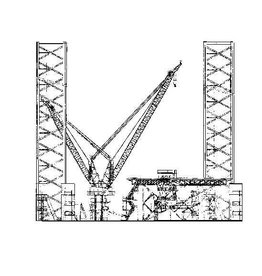
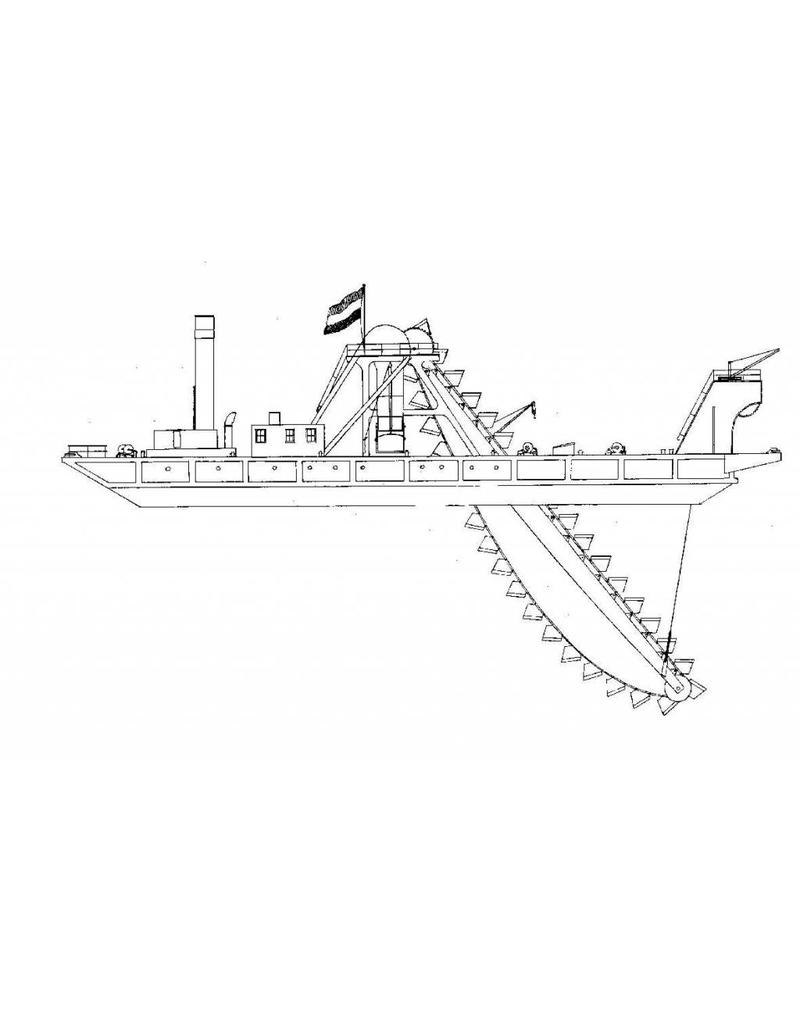
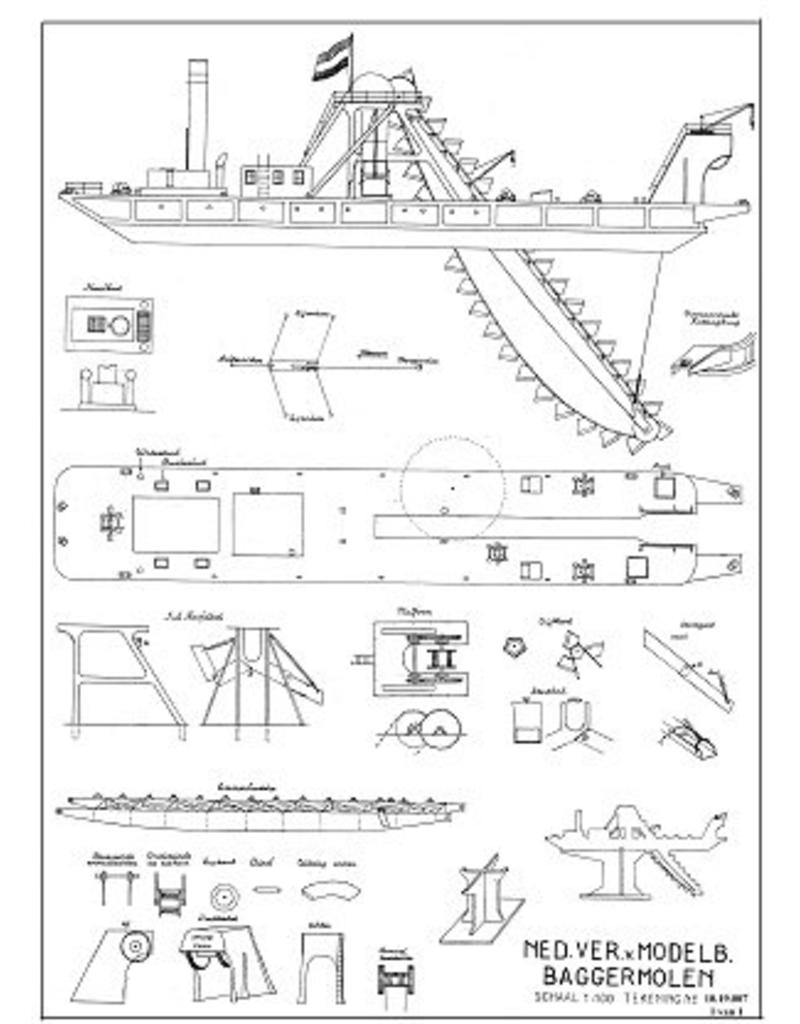
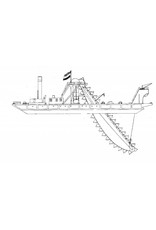
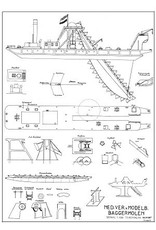
The dredger itself is actually mounted on a steel hull or pontoon. From the bow to approximately the middle of the hull along the longitudinal axis, an incision (called a well or 'bun') has been made. In the middle of the vessel stands the main gantry, a steel-constructed portal, on which the bucket ladder rests pivotally. This bucket ladder is suspended at its lower end from the ladder gantry, which is positioned near the bow of the vessel. The ladder gantry contains a lifting mechanism that lowers the ladder gantry to the desired depth to excavate the ground. During transport of the bucket dredger, the ladder gantry is largely lifted out of the water.
The bucket ladder serves to guide the bucket chain. This is an endless chain with long links, to which the buckets are attached. The bucket chain runs over a pentagonal drum, known as the 'vijfkant' (pentagon), at the upper end of the ladder, and over the 'zeskant' (hexagon) at the lower end, and further over rollers attached to the bucket ladder. The number of buckets is 30 to 40, and their capacity depends on the dredger's overall capacity. The capacity of a single bucket ranges between 300 and 850 litres. The buckets have replaceable hardened steel edges along the top to scrape the soil from the riverbed or seabed. In the bottom of each bucket, there are one or more holes to allow as much water as possible, contained within the bucket, to drain away during retrieval.
The full buckets are brought up, and their contents are collected in a hopper when they tip over the 'vijfkant'. The two connected discharge chutes transport the dredged material into a barge or well lying alongside the dredger. If a discharge chute is not in use, its lower part can be brought into a vertical position, so that the chute does not protrude beyond the vessel. A movable flap is installed in the hopper, making it possible to use either the left or the right discharge chute.
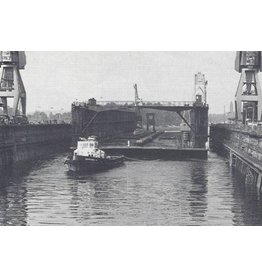
There are bucket dredgers with and without their own propulsion. In the latter case, a tugboat must move the dredger to a new project. At the dredging site, the bucket dredger moves by means of winches. On the deck of the dredger, winches are placed at the front, rear, and sides.[1] The cables of the winches are connected to anchors or fixed points on land. The winches on the sides move the dredger from one side of the river or channel to the other while dredging.[1] Then, the winch connected to the bow anchor is tightened and the stern line is slackened, moving the dredger forward.[1] Subsequently, the side winches are used again to dredge the next strip.
In 1953, what was then the largest and most modern dredger in the world was delivered. This diesel-electric dredger (Friesland) was commissioned by its owner, R. Boltje & Zonen NV from Zwolle, and equipped with above-deck accommodation for the crew. The vessel was also fitted with 4-metre-long anchor wire guide piles, allowing a bottom-dump barge to easily come alongside the dredger without touching the anchor wires. These modifications later became standard on dredgers both domestically and internationally.
Specifications:
|
Drawing number |
10.19.007 |
|
Author |
B.P. Tunderman |
|
Description |
bucket dredger |
|
Quality |
side view; deck plan; details |
|
Scale |
1 : 100 |
|
Number of sheets A00 |
0 |
|
Number of sheets A0 |
0 |
|
Number of sheets A1 |
0 |
|
Number of sheets A2 |
1 |
|
Number of sheets A3 |
0 |
|
Number of sheets A4 |
0 |
|
Total number of drawing sheets |
1 |
|
Number of A4 text sheets |
0 |
|
Weight in grams |
45 |
|
Particulars |
l.o.a. 40 cm |
|
Remarks |