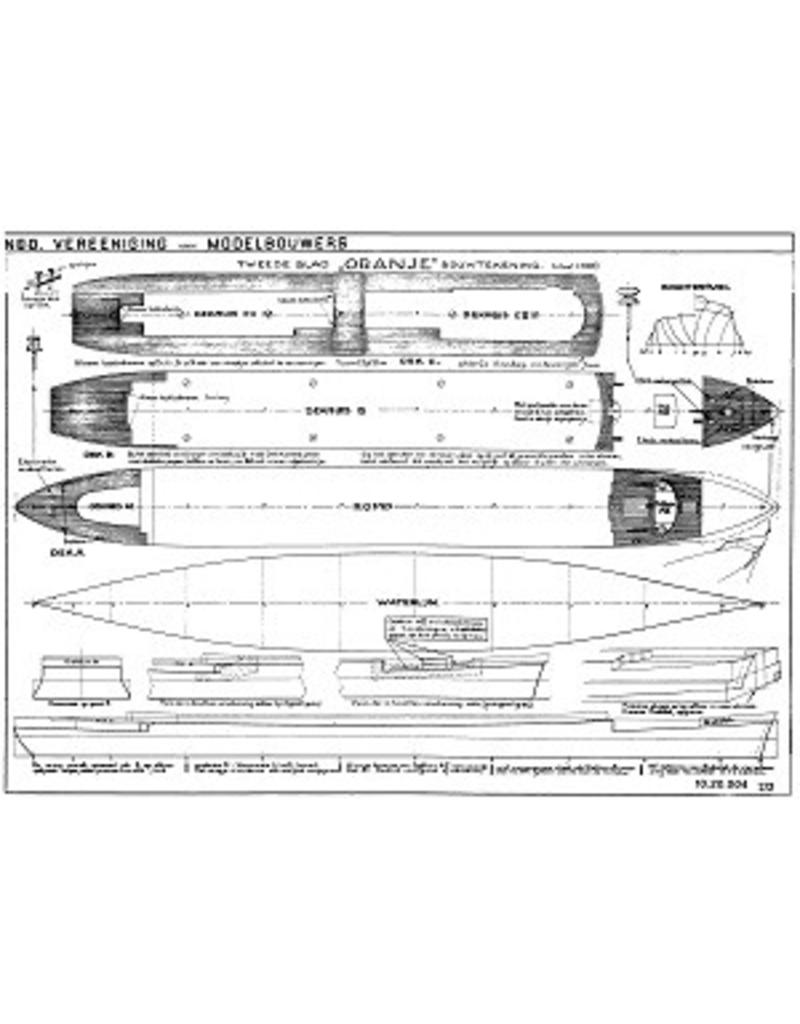
| Article number: | 10.20.004 |
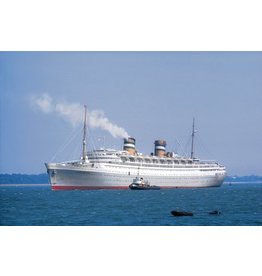
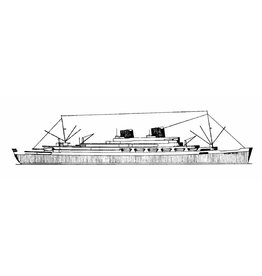
During a trial run of the motor vessel Oranje on Wednesday 28 June 1939, a maximum speed of 26.3 knots was reached in the North Sea. This made the new addition to the Stoomvaart Maatschappij Nederland fleet not only the largest, but also the fastest motor merchant ship in the world. This speed was made possible by the three 12-cylinder diesel engines, specially designed by the Swiss company Sulzer. The Oranje’s maiden voyage began on 4 September 1939, taking the ship from Amsterdam, via the Cape of Good Hope, to Batavia on Java in the Dutch East Indies. By that time, the Second World War had begun and, for safety reasons, the new passenger ship was laid up in Surabaya, also on Java, after a second voyage. The motor vessel was originally intended to be deployed as an auxiliary cruiser during the war, but the Dutch navy lacked the necessary armament and trained crew members. Consequently, in February 1941, the Dutch government offered the Oranje as a hospital ship to the governments of Australia and New Zealand. Both countries accepted the offer, partly because the conversion was to be carried out at the expense of the Dutch East Indies.
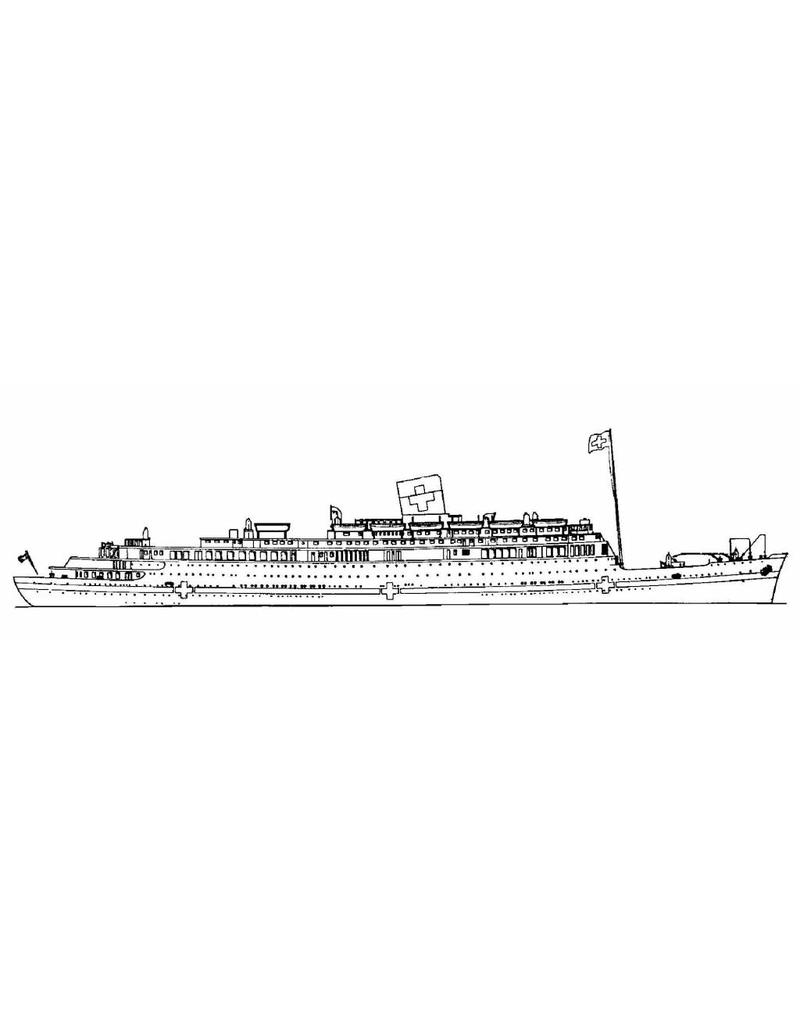
Captain B.A. Potjer was recalled from the United States to resume command of the Oranje. After the hull had been cleared of fouling in a dry dock in Singapore, the ship arrived via Batavia on 31 March 1941 in Sydney, Australia, to be converted into a hospital ship. The conversion took exactly three months and on 1 June 1941 the motor vessel was officially handed over to the Royal Australian Navy (RAN) as the Australian Hospitalship (AHS) Oranje. On board were an Australian and a New Zealand liaison staff. On 2 July 1941, the hospital ship set sail for Batavia, where a medical staff, including 15 doctors, most of whom were from the Dutch East Indies and under the command of Colonel J.C. Gerards of the Royal Dutch East Indies Army (KNIL), came on board. In addition to these staff, comprising a total of some 160 men and women, and the crew, there was room on board for 650 patients, a number which could be increased to 750 in an emergency.
Ten days later, the Oranje set sail for Sabang, North Sumatra, where it remained for six days. After the German and Italian governments had confirmed their recognition of the Oranje as a hospital ship, the motor vessel departed for Suez, where 641 wounded and sick soldiers were taken on board, who were subsequently disembarked at Fremantle, Adelaide, Melbourne, Sydney and Wellington. Until the occupation of the Dutch East Indies on 8 March 1942, the AHS Oranje made two further voyages to Suez, transporting 549 and 603 patients respectively. The occupation of Singapore, British Malaya and the Dutch East Indies marked the dawn of a new era for the Oranje. Previously, the ship had been able to call at Surabaya, Batavia and Singapore for fuel and supplies. Moreover, there was a dry dock in Singapore large enough to accommodate the ship, which weighed over 20,000 tonnes. After 8 March 1942, the ship was dependent on South Africa for supplies outside Australian and New Zealand ports. In Simonstown, near Cape Town, there was a dock that could accommodate the Oranje. For a maintenance overhaul, which required the Oranje to be docked, the hospital ship departed Sydney on 24 March 1942 and arrived in Simonstown on 21 April.
During the first fifteen voyages, Sydney served more or less as the Oranje’s home port. During this period, the ship not only made voyages between the Middle East, Australia and New Zealand, but also between the Middle East and South Africa, regularly calling at African ports such as Mombasa in Kenya. On 31 January 1944, the AHS Oranje set sail on her sixteenth voyage from Sydney to Durban and then via Aden, Suez, Malta and Gibraltar to England. On 14 March, the Oranje arrived in Avonmouth, near Bristol, where it was taken into a dock. The no fewer than eighteen voyages as a hospital ship undertaken in the period that followed all led to the Mediterranean. These voyages were made from British ports such as Southampton, Liverpool and Glasgow and had Port Said, Naples, Taranto, Malta and Gibraltar as their destinations.
On 10 July 1945, the Oranje departed from Great Britain via Colombo in Ceylon, bound for Australia. From there, four voyages were undertaken between the Far East, Australia, New Zealand and Batavia. On 28 November 1945, the Oranje departed from Melbourne, via Perth, Semarang and Batavia, bound for England, carrying 1,273 men and women who had been held in Japanese prison camps on Java. The ship arrived in Southampton on 5 January 1946, where the passengers were taken to Amsterdam by the British hospital ship Atlantis and the troop transport ship Almanzora, as the North Sea had not yet been opened to ships larger than 15,000 tonnes due to the danger of mines. By this point, the Oranje had made 41 voyages as a hospital ship, covering 382,260 nautical miles and transporting 32,461 patients.
On 18 July 1946, the ship, which had by then lost its status as a hospital ship, returned to Amsterdam after an absence of seven years. On this occasion, the ship passed through the restored Noordersluis lock in IJmuiden, which was reopened amid great public interest. In the 1950s, the MS Oranje resumed her services to Sumatra and Java. By the late 1950s, passenger numbers had fallen sharply and many passenger ships were converted into cruise ships. This was also the case with the Oranje, which, as a cruise and passenger ship, made voyages to the Mediterranean, Australia and New Zealand from 1958 to 1964. In 1964, the ship was sold to the Italian cruise line Lauro because it was no longer profitable under the Dutch flag. On 4 September, the name Oranje was definitively replaced by Angelina Lauro. Following extensive refurbishment and modernisation, the ship entered service as a cruise ship in the Caribbean. During a cruise in the Caribbean, the ship called at St. Thomas in the Virgin Islands with a predominantly American passenger complement on board. On 30 March 1979, a major fire broke out on board the cruise ship for reasons that remain unknown to this day. As the local fire brigade was unable to bring the fire under control, the ship was scuttled in a last-ditch attempt to extinguish the fierce blaze. The ship was subsequently salvaged and sold for scrap. On its way to the scrapyard behind a tugboat, the ship sank on 24 September 1979, over 1,750 nautical miles west of Managua in the Pacific Ocean
Technical data
|
Shipyard: |
Nederlandsche Scheepsbouw Maatschappij (NSM) in Amsterdam |
|
Ordered: |
23 April 1936 |
|
Laid down: |
2 July 1937 |
|
Launched: |
8 September 1938 |
|
Commissioned: |
1 July 1939 |
|
Overall length: |
200.1 metres |
|
Maximum beam: |
25.45 metres |
|
Draught: |
8.64 metres |
|
Displacement: |
20,117 tonnes |
|
Engine installation: |
3 x 12-cylinder Sulzer diesel engines |
|
Engine power: |
37,500 hp |
|
Number of propellers: |
3 |
|
Cruising speed: |
22 knots |
|
Maximum speed: |
26 knots |
|
Crew: |
383 |
|
Capacity as a passenger ship: |
283 first-class, 283 second-class, 148 third-class and 52 fourth-class passengers |
Specifications:
|
Drawing number |
10.20.004 |
|
Author |
J. 3Staalenburg |
|
Description |
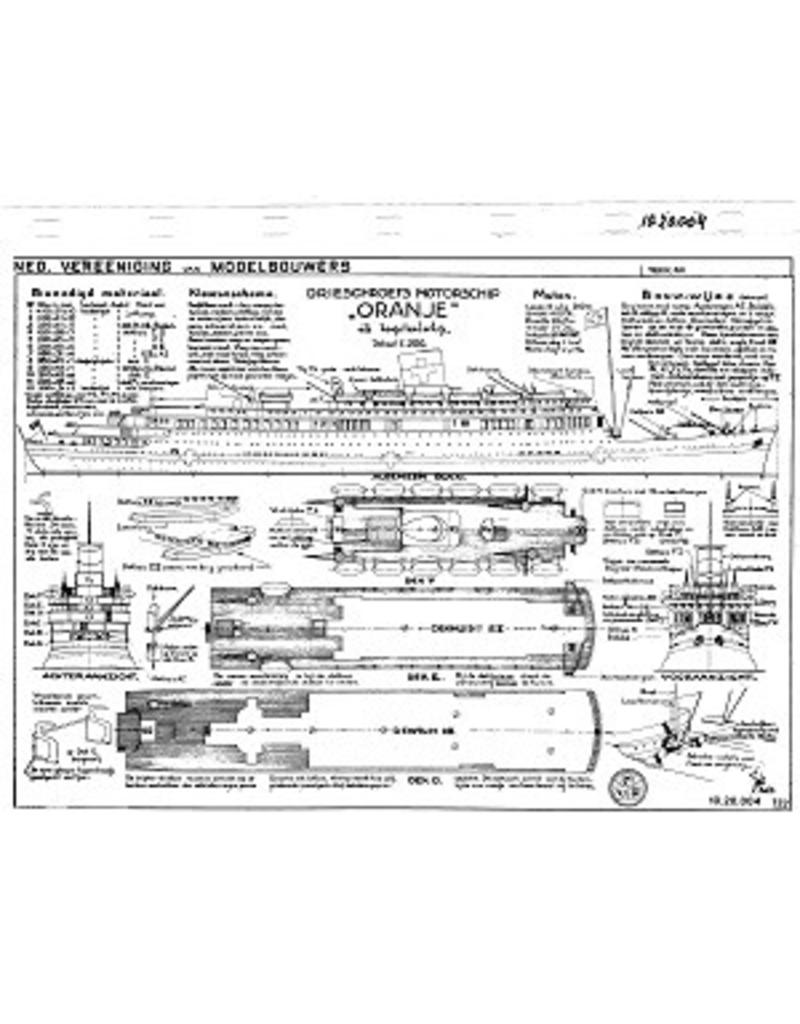
Passenger ship MS "Oranje"; SMN – as a hospital ship (1942–1945) |
|
Quality |
frames to the waterline; side view; fore view; deck plans |
|
Scale |
1 : 500 |
|
Number of sheets A00 |
0 |
|
Number of A0 sheets |
0 |
|
Number of A1 sheets |
0 |
|
Number of A2 sheets |
0 |
|
Number of A3 sheets |
2 |
|
Number of A4 sheets |
0 |
|
Total number of drawing sheets |
2 |
|
Number of A4 text pages |
0 |
|
Weight in grams |
45 |
|
Details |
total length 40 cm |
|
Comments |
Supplement item with pages from 2000/10 |