| Article number: | 50.02.002 |
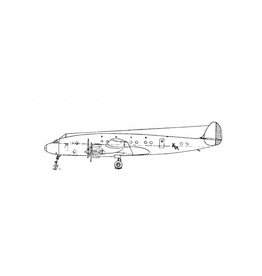
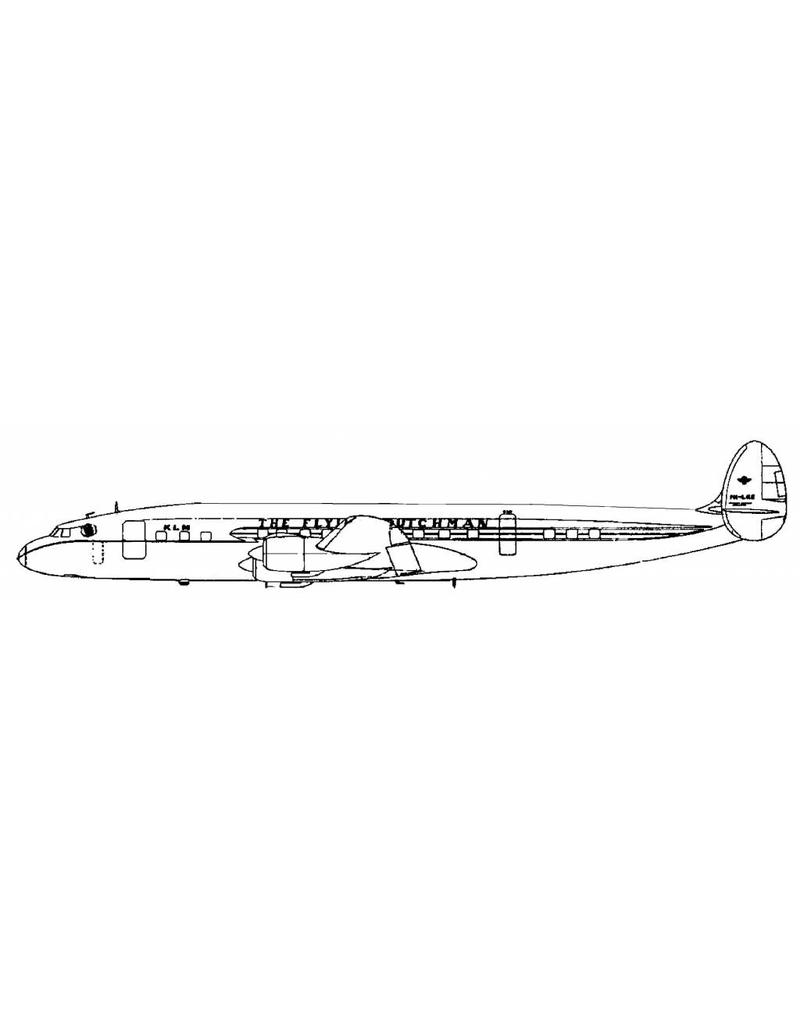
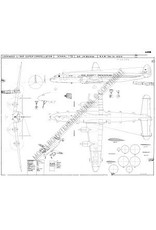
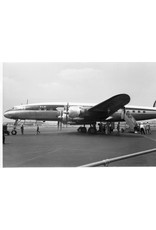
Lockheed L1049 Super Constellation
The Lockheed Constellation was a four-engine propeller aircraft built by the American aircraft manufacturer Lockheed.
Source: www.wikipedia.org/wiki/Lockheed_Constellation
The development of the Lockheed Constellation.
Development of the Lockheed Constellation began in 1939. The aircraft was developed on behalf of Howard Hughes, an eccentric millionaire and aviator who at the time held a majority stake in the airline TWA. Hughes wanted a four-engine aircraft with which he could beat all his competitors. However, the Second World War threw a spanner in the works. Military production took priority, delaying the development of the new aircraft. The first Constellation, which was soon affectionately nicknamed ‘Connie’, made its maiden test flight on 9 January 1943. Both the war and the engines, which were not yet working properly, led to delays. Towards the end of the war, the aircraft was deployed for troop transport. Immediately after the war, the first airlines began operating it; the first commercial model entered service with TWA in November 1945.
Hughes’ brainchild was not only large, but also fast. The aircraft, which weighed around 40 tonnes, flew faster than any other large passenger aircraft and, thanks to its pressurised cabin, could also fly at much higher altitudes. In 1944, with Hughes at the controls, the Constellation set the American ‘coast-to-coast’ record at just under seven hours. The Constellation featured many technical innovations. Moreover, for its time, the aircraft could cover enormous distances.
The Constellation’s elegant lines were partly the result of a number of practical choices. Chief designer Clarence “Kelly” Johnson was responsible for the design. The wing was, in fact, a larger version of that of the Electra, previously built by Lockheed. It was also the first civilian production aircraft with power-assisted steering. The Constellation was powered by a new type of Wright engine for the time: the R-3350 Cyclone engine. These are the largest air-cooled radial engines ever built by Wright. With these engines, the aircraft could maintain a cruising speed of 350 mph. The propellers fitted to them were so large that the aircraft required a very high landing gear. Furthermore, the designers were concerned that these powerful engines would cause air turbulence over the horizontal stabiliser. For this reason, the tail surfaces (keel and stabiliser) were positioned higher, resulting in the fuselage’s sloping shape. To give an aircraft of this size good directional stability, a keel with a large surface area was required. However, the aircraft also had to fit into the hangars that the airlines were using at the time. For this reason, it was decided to fit not one large but three smaller tail fins. Furthermore, the Constellation was the first large passenger aircraft with a pressurised cabin, enabling it to cruise at an altitude of 20,000 feet. This allowed it to fly above bad weather 90% of the time.
Ì´Ì_
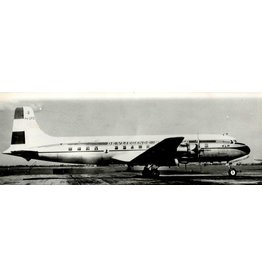
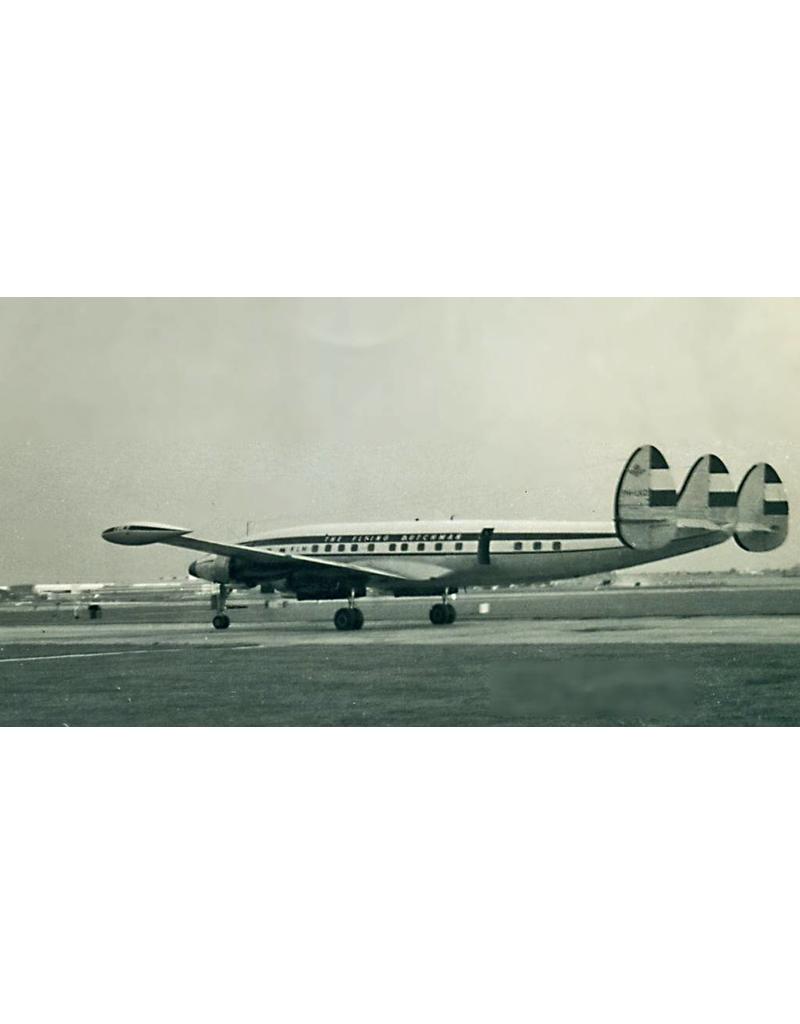
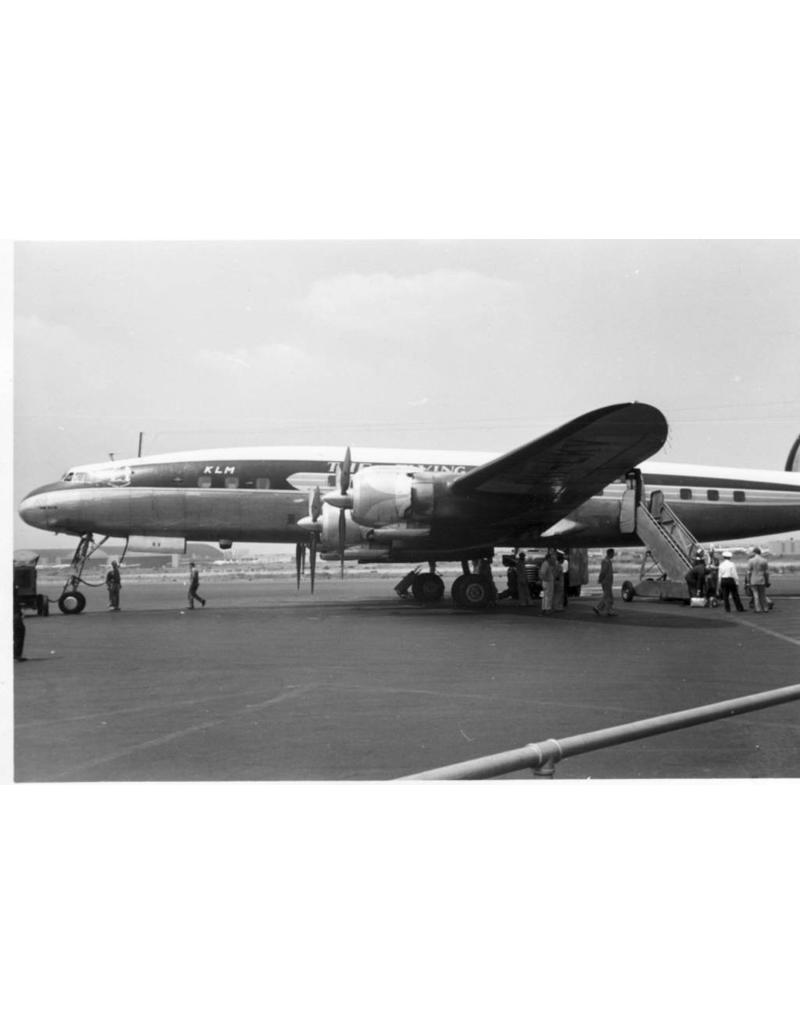
The Constellation in service with KLM.
After the war (1946), the Constellation formed the basis of modern Dutch civil aviation. On 21 May 1946, KLM became the first airline on the European mainland to launch a service to New York. Initially, this service was operated using Douglas DC-4 aircraft. The route was opened on 21 May of that year, with veteran Evert van Dijk as captain[1]. In the same month, the first Constellation was delivered to KLM. This aircraft played a major role in the expansion of routes across the Atlantic and the re-establishment of the connection with the then Dutch East Indies.
Ì´Ì_
Mauritius flights.
During the two police actions in 1947 and 1948 respectively, a number of countries refused to grant KLM permission to land on their territory. The alternative route in 1947 was flown via Ceylon (now Sri Lanka) across the Indian Ocean using the Douglas C-54 Skymaster. During the second police action in 1948, landing in Ceylon was no longer permitted either. An emergency route via the island of Mauritius was then followed in the first half of 1949. The Constellation was the only aircraft capable of covering the distance between Mauritius and Batavia – albeit barely. If the wind was against them, it could be that, at the ‘point of no return’ halfway across the ocean, they realised there was insufficient fuel remaining. They would then return to Mauritius or Batavia to try again the following day. The “point of no return” was marked by a Royal Navy submarine. To carry as much fuel as possible, the wings were sprayed with cool water during refuelling. [source?] Insurance for the aircraft and its occupants was provided by the Dutch government for this part of the flight.
Ì´Ì_
Further development of the model.
The Constellation underwent further development in the post-war years. First came the Constellation, later the Super Constellation, and then the Starliner. The fuselage was lengthened, the engines made more powerful, and additional fuel tanks were added, increasing the range, whilst the aircraft became quieter and safer. The latest version, the Lockheed L-1649, was introduced in 1957 and featured a completely new wing with even more fuel tanks. In total, Lockheed built 856 Constellations and Super Constellations, of which five were still flying in 2002.[source?]
Ì´Ì_
The end of an era.
KLM operated a total of 48 Constellations in various variants. In 1960, the piston-engine-powered Constellations became redundant with the arrival of KLM’s first jet aircraft: the Douglas DC-8. The Constellations were taken out of service. Initially, KLM was unable to sell the aircraft. For a long time, they stood covered on the edge of the apron. Some were fitted with a large cargo door at the front of the fuselage, so that they would be more attractive to buyers as combi-aircraft. This approach was not entirely successful: only a few were sold. All five L-749 Constellations were scrapped at Schiphol. Between 1962 and 1966, fifteen Super Constellations (L-1049) were also scrapped.[source?]
Ì´Ì_
A number of KLM Constellations remained in service with other airlines for a long time. Two still exist. One of them is on display at the Science Museum in Wroughton (England). This aircraft, the former PH-TET, was used in 1973 by the Rolling Stones, amongst others, as a tour plane for their tour of the Far East. There is also another KLM Constellation in South America: the new TAM Aeronautical Museum in Brazil managed to purchase one of the oldest Constellations, and also one of KLM’s first Constellations, an L-049 with construction number 2071. This aircraft was in service with KLM from 10 September 1946 to 21 June 1950 as PH-TAX Arnhem.
Ì´Ì_
The last Dutch Constellation.
Since 2003, there has once again been an airworthy Constellation in the Netherlands. It was initially purchased by the Constellation Netherlands Foundation. Under the leadership of the Aviodrome aviation museum in Lelystad, it was fully restored to its former glory by volunteers in the late 1990s. The aircraft has been painted in the colours in which KLM flew in the 1950s. The passenger cabin is not yet in its original condition.
This Constellation is of the VC-121A type (46-0612) and is a military version of the L-749A. The aircraft was commissioned by the US Air Force in January 1949 and was retired from service there in October 1967. It subsequently flew for Christier Flying Service Inc., Beaver Air Spray Inc. and Conifair. It was used as a crop-dusting aircraft. The aircraft was purchased in Canada on 17 November 1993 and subsequently underwent a 10-year restoration in the US. Aviodrome has the aircraft registered under the US registration: N749NL.
Ì´Ì_
Trivia.
The Constellation is affectionately referred to by pilots as ‘the best three-engine (propeller) aircraft in the world’. This is to indicate that the four-engine aircraft very often suffered engine failures whilst in flight.
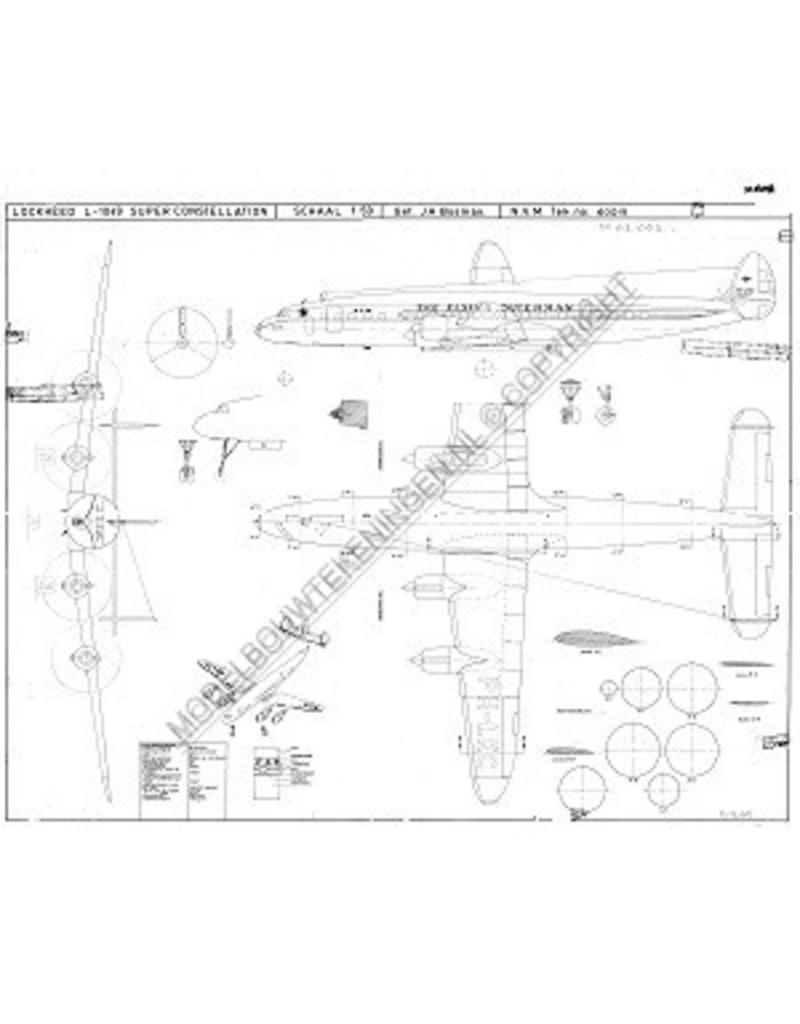
Specifications Model construction drawing:
|
Drawing number |
50.02.002 |
|
Author |
J.H. Bosman |
|
Description |
Lockheed L1049 Super Constellation |
|
Quality |
Ì´Ì_ |
|
Difficulty |
C |
|
Scale |
1 : 50 |
|
Number of sheets A00 |
1 |
|
Number of A0 sheets |
0 |
|
Number of A1 sheets |
0 |
|
Number of A2 sheets |
0 |
|
Number of A3 sheets |
0 |
|
Number of A4 sheets |
0 |
|
Total number of drawing sheets |
1 |
|
Number of A4 text pages |
0 |
|
Weight in grams |
105 |
|
Special features |
span 75 cm |
|
Comments |
Ì´Ì_ |