| Article number: | 10.01.019 |
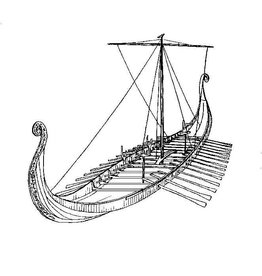
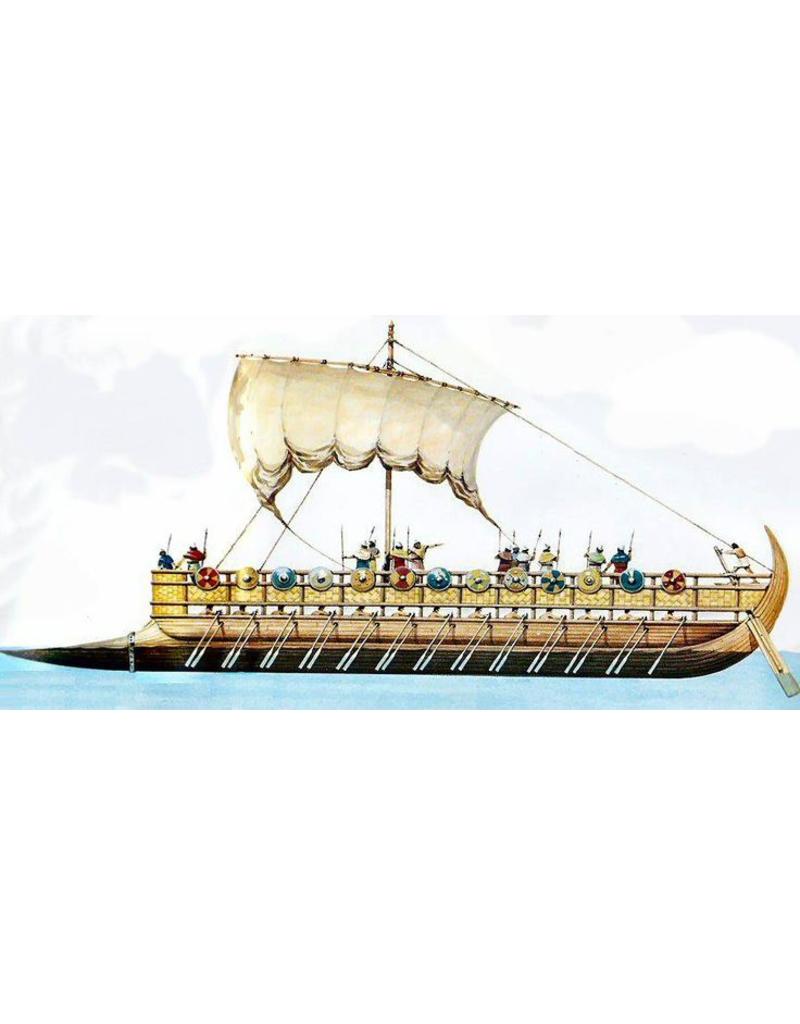
The Phoenician bireme with a combat bridge is an ancient type of warship used by the Phoenicians, an ancient seafaring people who flourished in the eastern Mediterranean, particularly from around 3000 BC to 500 BC. The bireme was a ship with two rows of rowers on each side, making it one of the most manoeuvrable and fastest warships of its time.
Bireme:
The term ‘bireme’ comes from the Latin word ‘biremis’, meaning ‘two oars’. This type of ship had two rows of rowers on each side, in contrast to the later triremes, which had three rows of rowers on each side.
The bireme was designed for speed and manoeuvrability, making it an excellent choice for naval battles and reconnaissance missions.
Combat bridge:
The boarding bridge (also known as a “boarding bridge” ) was a structure at the front of the ship used to board other vessels during combat. This bridge was often equipped with a hard wooden plank or a spike that was launched towards the enemy ship, allowing the crew to jump from one ship to the other.
The boarding bridge was an essential part of maritime warfare in antiquity, where the emphasis was not only on destroying ships by ramming, but also on boarding enemy vessels to capture them.
Role of the Phoenicians:
The Phoenicians were the pioneers of many of the maritime innovations in the ancient world, including the development of advanced ships such as the bireme.
They used their ships for both trade and warfare, and the bireme with a combat bridge was a powerful symbol of their naval power.
The Phoenicians were also famous for their trade networks, which stretched from Phoenicia (modern-day Lebanon, Syria and Israel) to Egypt, Greece, and even Etruscan Italy.
Use in Battle:
The Phoenician bireme with a boarding bridge was often deployed in naval battles where speed and offensive capability were crucial. The use of the boarding bridge was important for boarding tactics, where the aim was to overpower the enemy crew by overwhelming them, often through superior numbers and force.
Ramming enemy ships also remained a popular tactic, and the boarding bridge was seen as a means of penetrating the opponent’s vessels after ramming or cornering the enemy ship.
The Phoenicians were pioneers in the development of naval fleets, and their influence on maritime technology was adopted by later civilisations such as the Greeks and Romans. The bireme was eventually improved upon to become the trireme by the Greeks, who added three rows of rowers on the sides for greater speed and power.
The boarding bridge remained an important part of naval warfare until larger ships with more advanced weapons gained the upper hand in later times.
Specifications:
|
Drawing number |
10.01.019 |
|
Description |
Phoenician birème with battle bridge |
|
Quality |
cross-sections; views; details |
|
Scale |
|
|
Number of A00 sheets |
0 |
|
Number of A0 sheets |
0 |
|
Number of A1 sheets |
1 |
|
Number of A2 sheets |
0 |
|
Number of A3 sheets |
0 |
|
Number of A4 sheets |
0 |
|
Total number of drawing sheets |
1 |
|
Number of A4 text pages |
0 |
|
Weight in grams |
65 |
|
Details |
Overall length 52 cm |
|
Comments |
was 10.02.019 |